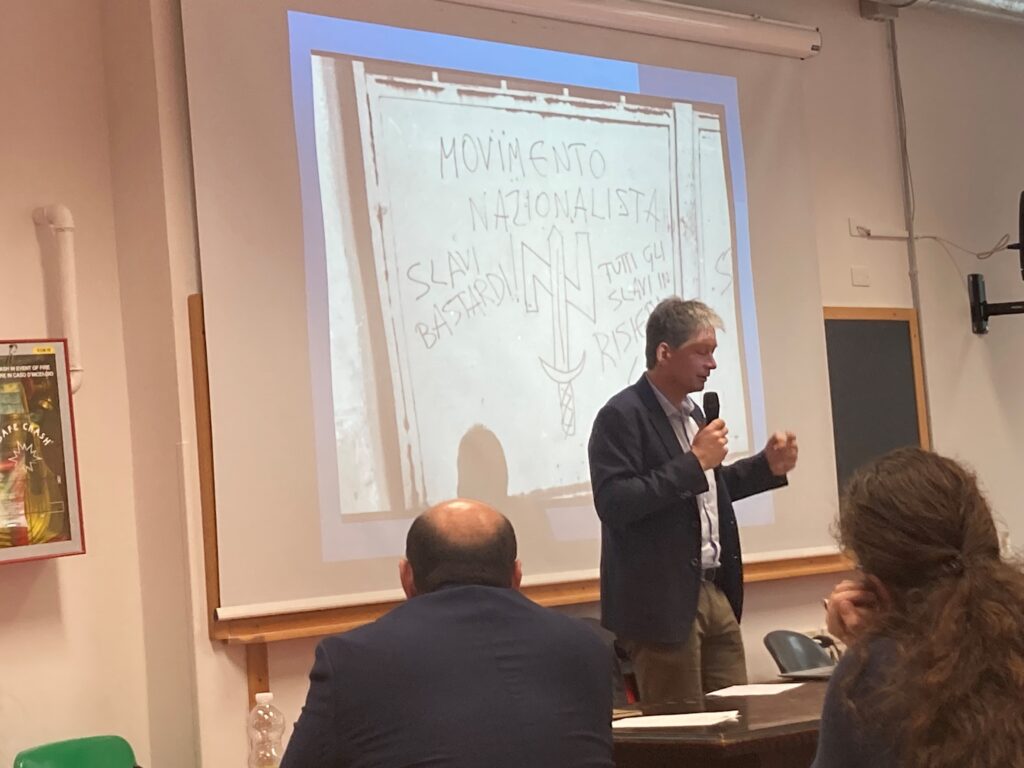
From 16 to 18 February 2026, the city of Trieste hosted a three‑day international beginner training titled “The Holocaust as a Starting Point”, which aimed to foster Croatian–Italian–Slovenian dialogue on Holocaust education. The programme took place at the University of Trieste (Università degli Studi di Trieste) and brought together 45 educators from the three participating countries.
The training was organised by Mémorial de la Shoah (France), the Education and Teacher Training Agency (Croatia), the National Education Institute of the Republic of Slovenia, the University of Trieste, and the Istituto Nazionale Ferruccio Parri, with the financial support of the Claims Conference and the German Federal Ministry of Finance.
A Three-Day Programme of Lectures, Discussions, and Workshops
The programme opened on 16 February with introductory activities and a historical lecture on the fundamentals of the Holocaust, delivered by Laura Fontana from Mémorial de la Shoah. These opening sessions were followed by discussions addressing the challenges of Holocaust education in the region, historical and contemporary antisemitism, and pedagogical approaches to using Holocaust photographs in the classroom.
On 17 February, special attention was given to a historical lecture by Dr Borut Klabjan from the Science and Research Centre Koper, who spoke about the shaping of the Northern Adriatic in the 20th century. In the afternoon, participants joined a guided visit to the former Nazi camp Risiera di San Sabba, led by Tullia Catalan and Matteo Perissinotto from the University of Trieste.
The final day deepened participants’ understanding of terminology related to mass atrocities and introduced historical insights into collection centres for refugees from the Julian March and Dalmatia. Educators also collaborated on the development of a joint learning activity. The seminar concluded at midday on 18 February with final evaluations and a closing session.
Strengthening Professional Competences and Cross-Border Cooperation
The training aimed to equip educators with knowledge and tools necessary for approaching the history of the Holocaust and mass atrocities with pedagogical sensitivity, responsibility, and critical reflection. At the same time, it provided a valuable platform for cross‑border cooperation, the exchange of good practices, and a deeper understanding of the shared histories connecting Slovenia, Italy, and Croatia.