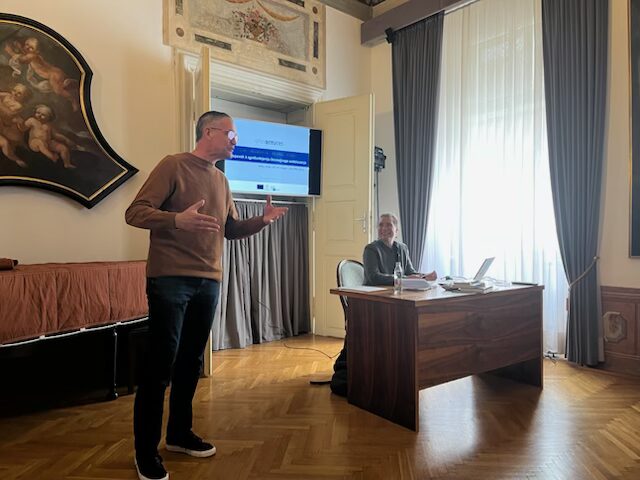
At a seminar organized by the Institute of Slovenian Ethnology, Urška Strle delivered a lecture titled “Hunting, Fishing, and the Cold War: A Contribution to the Historiography of Cross-Border Cooperation”. The event occurred on Tuesday, 19 May 2026, at 1:30 p.m. at ZRC SAZU. The lecture formed part of the project “Game in Border Regions,” which is led by dr. Miha Kozorog and co-funded by the Slovenian Research and Innovation Agency.
A historical perspective centered on hunting and fishing encourages a re-examination of both the chronology and the broader characteristics of cross-border cooperation between Yugoslavia, Italy, and Austria during the early Cold War period. The lecture develops these insights through three spatial perspectives. The first aspect addresses border areas as intersections of diverse hunting policies and as sites for the formation of cross-border hunting strategies. It was precisely these hunting grounds in the border zonethat, in 1952 and amid a gradual political thaw among the states involved, became the first arenas of structured cross-border cooperation between hunters. The second aspect focuses on the material dimensions of hunting and fishing tourism in Slovenia, particularly hunting and fishing lodges and related infrastructures that, from the late 1950s onward, also functioned as accommodation for foreign guests. These places can be understood as sites of cross-border encounter, exchange of practices and traditions, and occasional venues for so-called soft diplomacy. The third aspect focuses on international hunting and fishing fairs and exhibitions, which have played a significant role in developing and strengthening international ties, particularly since the 1960s. The various activities surrounding the presentation of hunting and fishing content can also be understood as arenas of political and ideological representation. Taken together, these three spatial dimensions form a strong nexus between the political and economic spheres, between local and international dynamics, and between natural environments and cultural practices.