

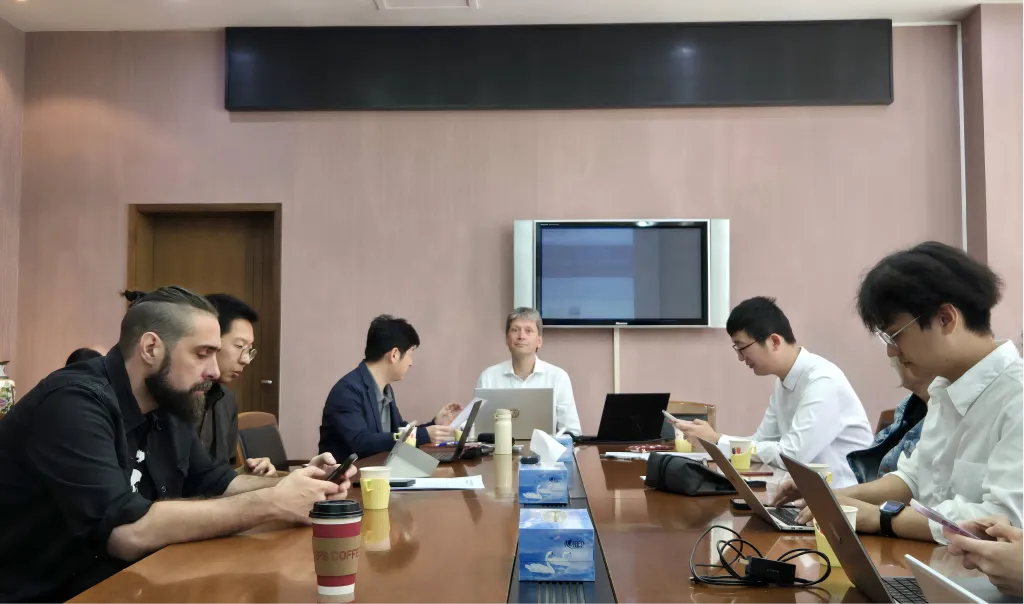
As part of the Balkan Studies Academic Week hosted by Capital Normal University in Beijing, Prof. Dr. Borut Klabjan (Science and Research Centre Koper, Slovenia) delivered a guest lecture on 21 May 2026 entitled“Open Borders in the Alps-Adriatic Region: Rethinking Border Regimes in Cold War Europe.” The lecture was chaired by Dr. Zhu Pengfei and attracted students and researchers interested in European history, border studies, and international relations.
Drawing on research conducted within the ERC-funded project Open Borders: Cold War Europe Beyond Borders, Prof. Klabjan challenged conventional perceptions of the Cold War as a period defined exclusively by closed borders and rigid geopolitical divisions. Instead, he presented the Upper Adriatic and Alps-Adriatic region as a unique laboratory for exploring cross-border interactions and the everyday practices that connected communities across political divides.
The lecture examined how local populations, institutions, cultural actors, and economic networks navigated and often transcended state-imposed boundaries. Through examples from the northern Adriatic borderland, Prof. Klabjan demonstrated that borders during the Cold War were not merely barriers but also spaces of exchange, negotiation, and cooperation. This perspective contributes to a broader understanding of Cold War Europe by highlighting the importance of transnational connections and regional experiences.
The event formed part of a wider academic programme bringing together leading scholars from Europe and China to discuss the history, culture, and politics of the Balkans and Eastern Europe. During his visit to Beijing, Prof. Klabjan also participated in the First China-Balkan Cultural Exchange Forum, further strengthening international academic dialogue and cooperation.
Following the Beijing event, Prof. Klabjan continued his working visit in China, including meetings with scholars at East China Normal University in Shanghai, where discussions focused on comparative perspectives on cross-border interactions and potential future research collaborations.
This lecture provided an important opportunity to disseminate project findings to an international audience and to promote innovative approaches to the study of borders, mobility, and transnational history in twentieth-century Europe.
The original Chinese-language lecture report can be accessed at: LINK